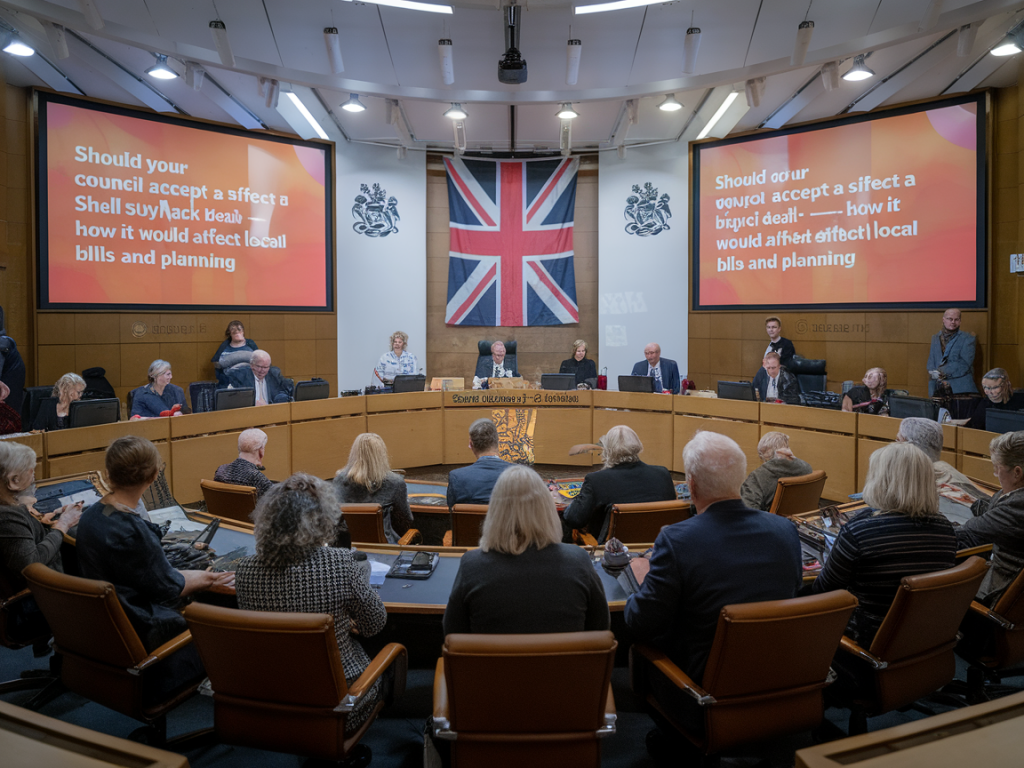
I was surprised the first time I read about a town council being offered a “solar buyback” deal by Shell. It sounds simple: the company installs solar panels on council-owned sites, sells the generated power back to the council or to residents, and pays the council a fee. But as I dug into the details, I realised this is the kind of local policy choice that sits at the intersection of planning, public finance, climate policy and community trust. If your council is being courted by Shell (or any large energy firm), here are the questions I’d want answered before voting yes — and the practical ways such a deal can alter local bills and planning decisions.
What exactly is a “solar buyback” deal?
In most cases the phrase refers to a third-party developer installing solar arrays on public land or rooftops, selling the electricity onto the grid or directly to consumers, and sharing revenue with the landowner — the council. Sometimes the council buys the power back at a discounted rate for its own buildings; other times the developer markets power to residents or businesses under a branded tariff. Shell’s participation usually means the deal is backed by a global energy giant with access to capital, project management and marketing channels.
Why councils find these deals attractive
I get the appeal. Councils face tight capital budgets and ageing buildings that need decarbonising. A third-party developer can offer:
For a council trying to cut bills and meet climate targets, that looks like a win. But the devil is in the contract.
How it can affect local energy bills
There are a few distinct scenarios to consider, and they change the impact on residents and the council’s own energy spending.
Which scenario applies will determine whether the deal lowers bills directly or simply increases council income. I like to think of two separate effects: (1) direct tariff savings to consumers, and (2) indirect savings through increased council revenues that can reduce council tax or fund services.
Key contractual and financial risks
Selling the idea of “free money” is easy; the complications are not. I would press for answers to the following before any council signs:
Planning implications and local control
Installing solar on roofs and brownfield land usually faces fewer planning hurdles than large ground-mounted sites, but councils should not treat planning as a rubber stamp. I’d expect rigorous local engagement on:
Community benefits and fairness
A deal can be more than a balance sheet item. The best proposals include direct community benefits: reduced tariffs for low-income households, training and job opportunities for local contractors, and clear plans for allocating revenue to council priorities. Without these elements, I worry about seeing public assets monetised while local residents see little benefit.
| Item | Potential short-term effect | Potential long-term effect |
|---|---|---|
| Council energy costs | Decrease if council buys power | Stable or decline depending on indexation and maintenance |
| Resident bills | Decrease if offered tariff; variable uptake | Depends on contract; could lock in benefits or leave residents behind |
| Council income | Immediate lease or revenue share | May erode with inflation or market shifts |
| Planning flexibility | Minimal impact for rooftop schemes | Long lease could restrict future development |
Should your council accept a Shell deal? My checklist
If I were advising a council, I’d push for a rigorous checklist before signing anything:
Deals with Shell bring scale and financial muscle, but they also bring long-term dependency on a corporation with competing global priorities. I’m not against partnering with big firms, but I insist on reciprocity: the community must gain clear, verifiable benefits and not just be a convenient asset on a balance sheet. The question isn’t only whether the electricity will be cheaper next year — it’s whether this is the right path for local democracy, planning flexibility and long-term climate action.