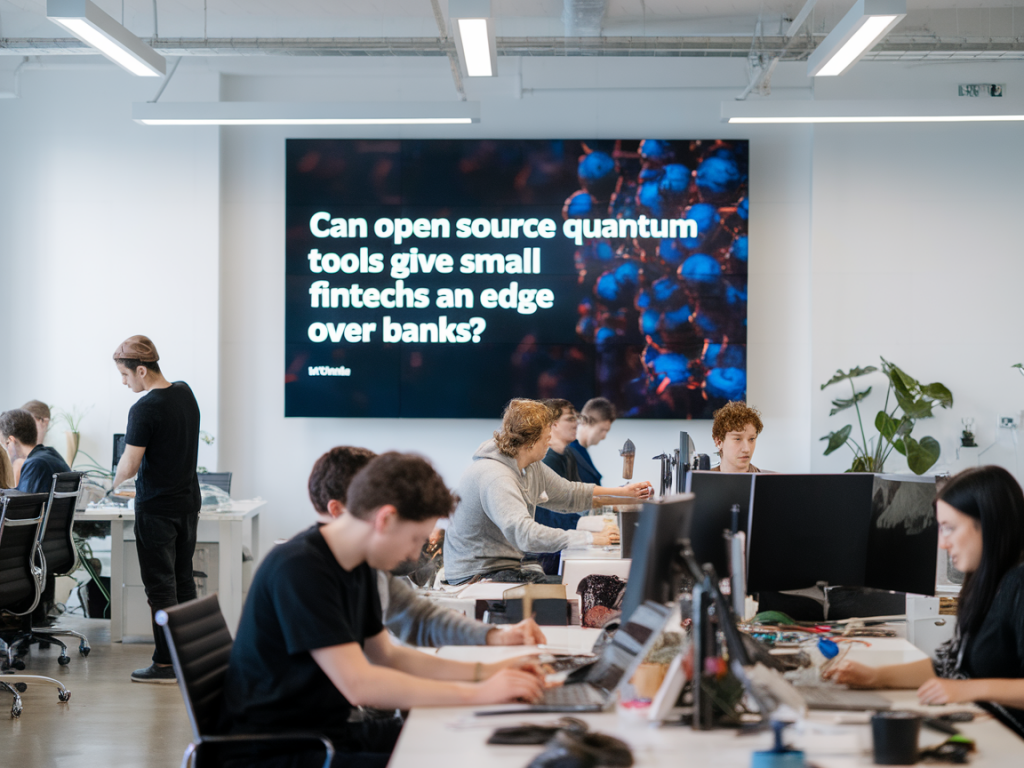
I’ve been watching the quantum landscape with a mix of fascination and skepticism — fascinated by the promise of fundamentally different computing primitives, skeptical because the headlines often leap from lab milestones to business revolutions. For small fintechs wondering whether open-source quantum tools can realistically give them an edge over incumbent banks, the honest answer is layered: yes, but not in the way many expect. The edge is more likely to come from experimentation, speed-to-innovation, and niche optimization rather than immediate, sweeping superiority in production systems.
Why open-source quantum tools matter to fintechs
Open-source quantum frameworks like IBM’s Qiskit, Google’s Cirq, Xanadu’s Pennylane, and the community around Q# and OpenFermion lower the entry barrier. For a small fintech, that matters for three reasons:
That combination can let a nimble fintech prototype ideas faster than a large bank burdened by legacy tech stacks and procurement cycles. But prototyping is not the same as production advantage.
What problems might actually benefit first?
Quantum advantage is most plausible in near-term devices for problems that can be framed as optimization, sampling, or certain linear algebra subroutines embedded into hybrid workflows. For fintechs, practical starting points include:
None of these guarantees an immediate ROI. But a fintech that finds even a modest performance improvement on a recurring, high-value calculation can translate that into cheaper infrastructure or differentiated product capability.
What open-source stacks enable today
Here’s what you can practically do with the current open-source tooling and cloud backends:
These capabilities let a small team build reproducible proofs-of-concept and compare hybrid approaches against purely classical baselines without heavy capital expenditure.
Real constraints you need to plan for
When I talk to fintech founders, common pushbacks surface quickly:
These aren’t reasons to avoid quantum exploration, but they are reasons to be deliberate. The smart play is to treat quantum as a strategic R&D stream rather than a drop-in replacement for your core stacks.
How a small fintech can get a practical edge — a playbook
I recommend a pragmatic three-stage approach for teams that want to convert curiosity into value:
Along the way, leverage these practical levers:
Comparing popular open-source quantum tools
| Tool | Strengths | Best for |
|---|---|---|
| Qiskit | Strong IBM hardware integration; rich tutorials; ecosystem (Terra, Aer, Ignis) | General prototyping, education, IBM cloud access |
| Cirq | Close to hardware for Google-style devices; good for circuit-level control | Low-level circuit experiments, Google backend |
| Pennylane | Differentiable quantum ML; easy integration with PyTorch/TensorFlow | Hybrid quantum-classical ML models |
| Q# (Microsoft) | Language-focused with tooling in Visual Studio; emphasis on developer experience | Algorithm development, Azure Quantum workflows |
Where the competitive edge is realistic
Small fintechs are unlikely to out-compute large banks on raw throughput in the short term. But they can out-innovate them in areas that favor rapid iteration, lean experimentation, and targeted differentiation. That edge manifests in:
I follow these developments closely at Latestblog Co (https://www.latestblog.co.uk), and I see the same pattern over and over: technology incubates advantage in the hands of the agile, but only when experiments are tied to realistic product and compliance roadmaps. If you’re a fintech leader, treat open-source quantum tools as a lever for strategic experimentation — not a magic bullet. Build the muscle now, so that when hardware and algorithms mature, you don’t have to start from scratch.