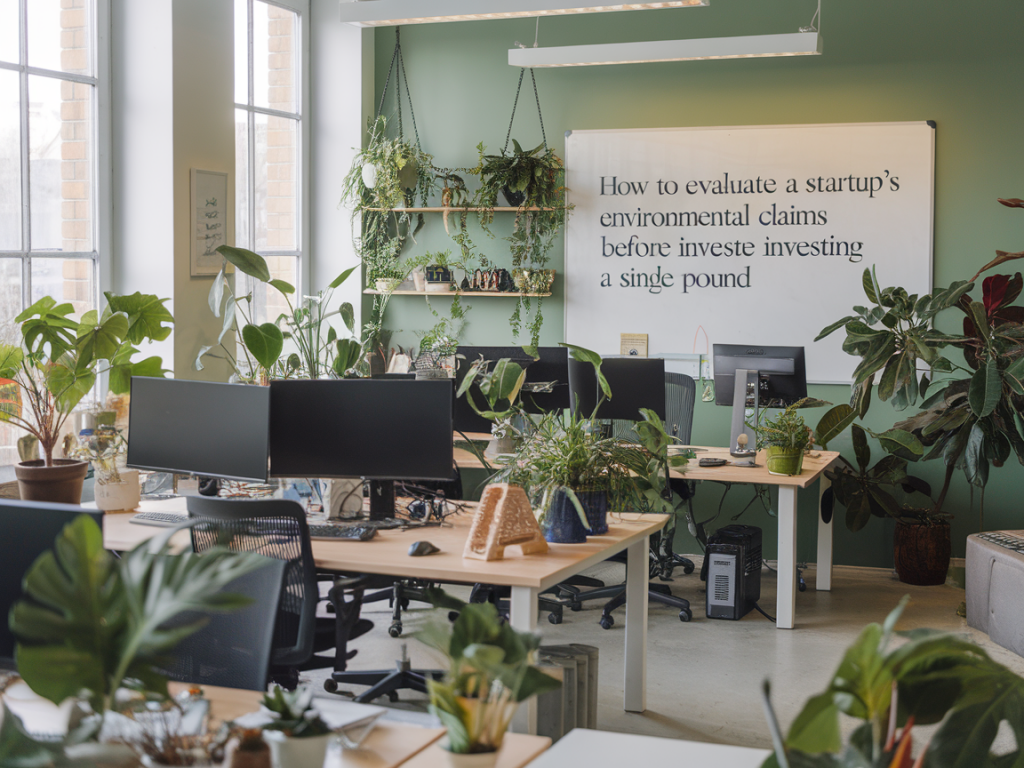
I remember the first time I was tempted to back a startup because its mission sounded like a tidy moral compass: the founders promised to “save the planet” with a biodegradable packaging technology. The pitch deck was glossy, the prototypes looked promising, and my instinct to support purpose-driven businesses was loud. But as a reporter trained to dig beyond rhetoric, I held my cheque. Over the years I’ve developed a practical checklist for evaluating environmental claims before investing a single pound — a method that balances skepticism with openness to genuine impact. Below I share that approach, the questions I ask, the evidence I look for, and the red flags that make me walk away.
Start with the claim: be specific
First, parse the claim carefully. “Sustainable,” “eco-friendly,” and “green” are marketing-friendly but meaningless without context. I ask: what exactly are they claiming?
A precise claim is easier to verify. If the founders can’t state the metric (e.g., “reduces CO2e by X kg per unit” or “uses 70% recycled feedstock”), that’s an early warning sign.
Ask for evidence — not just promises
Words matter far less than data. I ask for:
When a startup produces a life cycle assessment (LCA), pay attention to its scope. Is it cradle-to-gate, cradle-to-grave, or gate-to-gate? A narrow LCA can make improvements look larger than they are. If they cite reductions in carbon intensity, ask for the conversion factors and assumptions behind that number.
Look for credible third-party validation
Independent verification matters. Certifications and audits vary in rigor — some are meaningful, others are essentially self-declared. I favour these types of validation:
If a startup points to a “certificate,” I Google the issuing body to check its reputation. A cute badge isn’t proof of impact.
Examine the supply chain — most impact happens upstream
Many startups optimise one part of a product while ignoring the rest of the supply chain, which can negate any benefit. I ask founders about sourcing of raw materials, manufacturing partners, and transport emissions.
I also look for traceability tools: batch-level tracking, supplier audits, and digital traceability platforms (e.g., provenance systems). If supply chain details are vague, assume the environmental case is weaker than advertised.
Understand the counterfactual — what happens if the startup doesn’t exist?
This is a favourite analytical trick of mine. Real impact is relative to what would have happened otherwise. I evaluate whether the startup:
For instance, a compostable packaging solution only reduces landfill impact if consumers and municipal systems actually compost it. Without collection infrastructure, claims of circularity can be hollow.
Assess scalability and rebound effects
A technology that works in a lab or in small pilots may falter at scale. I probe how the environmental benefits scale with volume and whether there are rebound effects (where efficiency gains lead to increased consumption).
Scalability plans should include realistic timelines, supply commitments, and capex estimates. Without them, the path from prototype to impact is speculative.
Financial and governance alignment with environmental goals
Environmental promises must be embedded in governance. I look for concrete commitments in company documents and behaviour:
A founder-led sustainability culture helps, but institutionalising it through governance is more durable.
Watch for greenwashing red flags
Some common red flags I’ve learned to spot:
If someone avoids sharing basic evidence under the guise of “trade secrets,” that’s a legitimate concern — many environmental claims can be substantiated without exposing proprietary IP.
Practical questions to ask founders — my go-to checklist
A small table to compare claim vs verification quickly
| Claim | What to request | Red flag |
|---|---|---|
| “Carbon neutral product” | LCA, emissions inventory, offsets used, verification body | Offsets only, no emissions reduction plan |
| “Biodegradable” | Degradation testing reports under relevant standards (industrial vs home compost) | No test details; claim only applies in lab conditions |
| “Made from recycled materials” | Percentage of post-consumer recycled content, supplier audits | Unclear sourcing, or “recycled” means downcycled at low value |
Tools and resources I use
Over the years I’ve compiled a set of useful resources that help verify claims:
If you’re an investor without in-house expertise, consider budgeting for an expert audit. Spending a few thousand pounds on due diligence can avoid backing a company whose environmental case collapses under scrutiny.
When I invest, I want to be confident that environmental claims are rooted in measurable outcomes, credible verification, and durable governance. Protecting capital and protecting the planet aren’t mutually exclusive — but they do require more than good intentions. Ask for the data, press on the assumptions, and prioritise transparency. If founders can’t or won’t engage with those questions, I treat that as part of the investment risk.