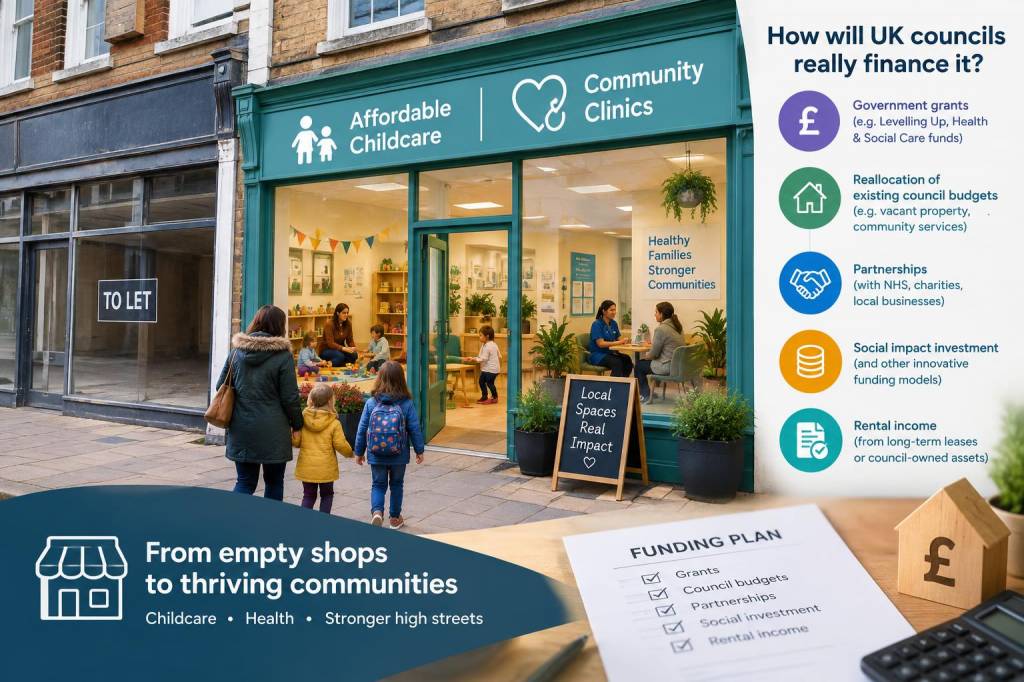
I’ve been watching our high streets with a mix of nostalgia and impatience. Empty shopfronts tell a story of shifting retail habits, but they also offer a practical opportunity: repurposing those units into affordable childcare spaces and community clinics could tackle two urgent problems at once — accessible early years provision and overstretched primary care. The big question, though, is always the money. How will UK councils really finance these conversions in a context of squeezed budgets and competing priorities? Here’s how I see it — pragmatic, politicised, and necessarily creative.
What are the financing levers available to councils?
Councils don’t have a single pot of magic money. They stitch together funding from a mix of public, private and community sources. The main levers are familiar to anyone who follows local government finances, but their combination and sequencing are what make projects feasible.
Central government grants: the Department for Education (DfE) and Department of Health and Social Care (DHSC)/NHS periodically offer capital grants for childcare expansion and health infrastructure. These are competitive and often earmarked for specific priorities, but they can cover a substantial chunk of retrofit costs.Levelling Up Fund and UK Shared Prosperity Fund: both have been used to revitalise town centres and support community facilities. Local authorities with strong bids can secure tens of millions for projects that boost town centre footfall and social infrastructure.Section 106 (S106) and Community Infrastructure Levy (CIL): these developer contributions can be allocated to community uses, including health and childcare. Availability varies by local plan and housing pipeline.Business rates reliefs and retention: councils can leverage short-term business rates relief to incentivise landlords to offer lower rents for community uses or use their retention powers to prioritise regeneration zones.NHS capital and estates funding: for community clinics, NHS England funding streams and local Integrated Care Boards (ICBs) are critical. There’s also potential to use estate transformation funds to relocate GP services into more accessible town centre locations.Public–private partnerships (PPPs) and leasing deals: councils can negotiate peppercorn or low-rent leases with landlords in exchange for fit-out commitments, or enter joint ventures with housing associations and social enterprises.Social finance, bonds and blended finance: social impact investors, repayable grants, and community municipal bonds can cover upfront costs while delivering measurable social returns.Community shares and philanthropy: community-owned hubs can raise capital from local residents and charitable foundations, especially where there’s visible local demand and community buy-in.How much does a conversion cost?
Costs vary widely by unit size, condition and required compliance (e.g., safeguarding and infection control). A rough range for a modest high-street shop conversion:
- Basic fit-out for a small childcare setting: £50,000–£150,000
- Full conversion including external works, outdoor playspace and compliance upgrades: £150,000–£400,000
- Clinic conversion with clinical rooms, waiting area and safe waste handling: £100,000–£300,000
These figures exclude ongoing revenue costs (staffing, utilities, supplies), which are often the tougher nut to crack. Capital grants can build the space; sustainable revenue models pay for running it.
What models make projects sustainable?
My reporting and conversations with council leaders suggest a few replicable models:
Long-term lease + cross-subsidy: councils secure long leases at reduced rents and then sub-let to a childcare provider or GP practice. Income from mixed-use spaces (e.g., community café, co-working) can subsidise the social services.Anchor tenant model: an NHS or large childcare provider signs as anchor tenant, attracting grant funding and making lenders comfortable with predictable income.Community-owned hubs: community share offers and charity governance deliver strong local legitimacy and access to philanthropic capital, though they require local capacity to manage operations.Joint ventures with housing associations: these partners can bring capital and long-term asset management expertise, linking health and childcare to broader regeneration schemes.Where are the risks and bottlenecks?
There are political and practical risks that commonly derail projects:
Timing and conditional grants: funding is often short-term and conditional, pushing councils into a race to deliver without long-term revenue clarity.Landlord cooperation: securing favourable lease terms on privately owned units is unpredictable. Some landlords prefer vacancy to avoid altering property asset classifications.Revenue gap: even with capital funding, staffing costs for childcare and clinical services can outstrip fee income or contract revenues, especially if services are priced affordably.Planning and regulatory hurdles: change-of-use applications, safeguarding requirements for childcare, and CQC registration for clinics can extend timelines and increase costs.Equity and access: converting high-value retail space into social services must be balanced against displacing new retail entrepreneurs or changing the character of town centres.What practical steps should councils take now?
I’ve spoken to council officers who’ve had success. They follow a pragmatic sequence:
Map demand and assets: identify where childcare shortages and clinical access gaps overlap with empty units. Use NHS and local early years data, then shortlist feasible sites.Secure short-term occupancy agreements: flexible, interim uses reduce vacancy and build a case for conversion while allowing time for funding applications.Assemble blended funding packages: combine small pots — DfE capital grants, Levelling Up bids, CIL, social investment — rather than waiting for a single big award.Negotiate landlord partnerships: offer fit-out contributions in exchange for long leases; craft rent-review clauses tied to social outcomes.Design with operational partners early: involve childcare providers and GP federations in design to control revenue models and staffing needs.How can national policy make this easier?
From where I sit, national policy can unlock scale in three ways:
Longer-term, flexible capital pots: not one-off competitive rounds, but multi-year funding streams for social infrastructure across town centres.Revenue support for early years and community health pilots: bridge funding for the first 3–5 years helps projects reach financial sustainability.Stronger incentives for landlords: tax breaks, business rates relief or matching grants to convert empty retail into community uses would change landlord calculus.Who’s already doing it well?
Examples range from councils repurposing high-street units into children’s centres to GP practices relocating into town centre premises with council-backed fit-outs. Brighton, for instance, has experimented with pop-up community clinics; some metropolitan boroughs have used Levelling Up allocations to create mixed-use social hubs. These pilots show that success depends less on a single funding source and more on local cross-agency collaboration.
Quick comparison of common funding options
| Funding source | Typical use | Main advantage | Limitation |
| DfE / DHSC grants | Capital fit-out | Dedicated, sizeable | Competitive, ring-fenced |
| Levelling Up / UKSPF | Town centre regeneration | Can fund complementary works | Political, variable allocations |
| S106 / CIL | Community infrastructure | Local control | Dependent on development activity |
| Social investment | Repayable capital | Flexible, scalable | Requires measurable outcomes |
| Community shares | Local buy-in | Builds stewardship | Limited scale |
Turning empty high-street shops into affordable childcare and community clinics is financially complex, but far from impossible. It requires councils to be creative funders, skilful negotiators with landlords, and honest partners with health and childcare providers. If local leaders can stitch together blended capital, secure revenue support, and build strong operational partnerships, these projects can deliver real social return — and give our high streets a renewed, purposeful life.