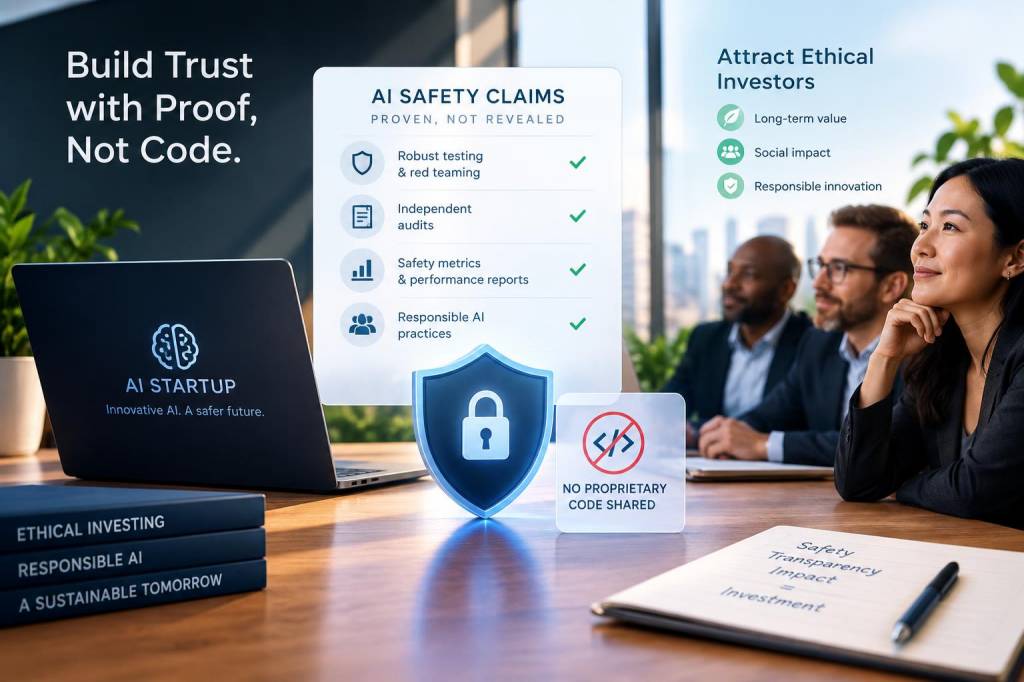
I’ve watched early-stage AI companies struggle with a real paradox: ethical investors want evidence that models are safe, robust, and non-abusive — but startups are terrified that showing too much technical detail will reveal the secret sauce. I’ve advised founders and talked with ESG-minded VCs enough to see that this tension doesn’t have to be zero-sum. There are pragmatic, credible ways to prove safety without handing your IP to competitors.
Start with clear, auditable claims
The first mistake founders make is being vague. “Our model is safe” or “we mitigate bias” won’t convince anyone. I recommend turning broad assertions into specific, testable claims that you can back with evidence. For example:
- Claim: “Model X refuses to generate instructions for creating weapons.”
- Claim: “The classifier maintains parity in false positive rates across demographic groups A and B within ±2% on our benchmark.”
- Claim: “We limit hallucinations to under 5% on domain-specific queries as measured by our labeled test set.”
Specific claims allow you to define the metric, the evaluation dataset, and the acceptable threshold — which in turn makes verification possible without disclosing training code or weights.
Use standardized artifacts that protect IP
There are established artifacts you can produce that show rigorous work without exposing proprietary models:
- Model cards and risk assessments: Publish a model card (following Mitchell et al.) and a structured risk assessment that documents intended use, limitations, known failure modes, and mitigation strategies.
- Datasheet summaries: Provide datasheet-level information about training data provenance and labeling practices without releasing raw datasets.
- Evaluation suites and unit tests: Create reproducible evaluation harnesses and share the scoring scripts and test inputs (or suitably obfuscated versions). Investors can run these against a hosted API rather than your model binary.
Staged transparency: who sees what and when
I advise founders to think in layers of disclosure:
- Public disclosures: High-level documentation, model cards, benchmark results on public datasets, SOC 2 / ISO statements, and a summary of safety engineering processes.
- Controlled technical disclosures: For serious investor due diligence, provide access to a sandboxed API, a red-team report, or a third-party audit under an NDA.
- Escrow / selective reveal: If a legal or financial transaction is imminent, use IP escrow or escrowed artifacts (for instance, model weights encrypted and released to a neutral auditor under specified conditions).
Layering disclosure protects core IP while satisfying different levels of investor scrutiny.
Third-party attestations and independent audits
Independent verification matters to ethical investors. They don’t simply want to believe you — they want a neutral voice. Useful options include:
- Security audits: Firms like Trail of Bits, NCC Group, or Mandiant can run threat modeling and code audits. These reports can be redacted for public release and fully shared under NDA.
- AI safety labs: Emerging specialist auditors perform model-behavior audits — assessing toxicity, jailbreakability, or model extraction risk — and can provide written attestations.
- Compliance certificates: SOC 2, ISO/IEC 27001, and data protection impact assessments (DPIA) show you take governance seriously even if they don’t speak to model behavior directly.
Prove behavior through controlled APIs and demos
One of the cleanest ways to demonstrate safety without releasing code is controlled interactions. I encourage startups to:
- Offer an investor sandbox API with rate limits, monitored queries, and logging. Investors can run adversarial probes themselves while you retain control of outputs and telemetry.
- Provide a replayable demo environment: prerecorded adversarial prompts and model responses demonstrating mitigations in action.
- Publish challenge-response benchmarks where results can be verified without revealing model internals. For instance, host a scoring endpoint that returns only a pass/fail or a metric, not raw logits.
Cryptographic and computation-based attestations
For higher assurance there are more technical approaches that protect IP:
- Remote attestation: Use trusted execution environments (TEEs) such as Intel SGX or AWS Nitro Enclaves to run the model in a way that proves — cryptographically — what code executed and what outputs were produced, without revealing the model itself.
- Encrypted inference and MPC: Techniques like homomorphic encryption or secure multi-party computation (MPC) can demonstrate certain properties of your model without revealing weights.
- Zero-knowledge proofs (ZKPs): These are experimental for complex ML models but can, in theory, prove statements about model behavior (e.g., that a model never outputs a disallowed class) without exposing internals.
These approaches raise the bar but can be overkill for many early-stage firms; they are, however, compelling for deep-pocketed ethical investors who demand cryptographic guarantees.
Make adversarial testing and red teaming routine
I’ve seen the most credible companies bake adversarial testing into their development cycle. Practical steps:
- Run internal red teams and publish sanitized summaries: types of jailbreaks attempted, success rates, mitigations added, and remaining risk.
- Host public and private bug bounties to incentivize the security community to find weaknesses. Offer monetary and recognition incentives while using legal safe-harbor terms.
- Keep an incident register and post-mortems: investors trust teams who show they learn quickly and adapt.
Contractual and governance tools that matter
Safety is also governed by contracts and organizational practices:
- Clear usage and licensing terms: Spell out prohibited uses and termination rights for misuse. Investors want to see enforceable user agreements.
- Audit and monitoring clauses: Allow limited auditing rights in term sheets or investment documents so a trusted third party can periodically verify compliance.
- Board-level oversight: A safety or ethics advisor (or an independent safety board) signals governance maturity.
Tell a credible narrative backed by data
Finally, presentation matters. I coach founders to combine data with story: describe the risk landscape you’re trying to mitigate, the engineering and process investments you’ve made, and the measurable results. Use visual dashboards (masked if needed) to show trends in safety metrics, incident rates, and remediation timelines.
Ethical investors don’t want theatrical transparency; they want reproducible, auditable, and honest evidence that risks are being managed. If you can provide specific claims, verifiable artifacts, independent attestations, and controlled ways for investors to test behavior — you’ll open doors without giving away your model’s secret recipe.