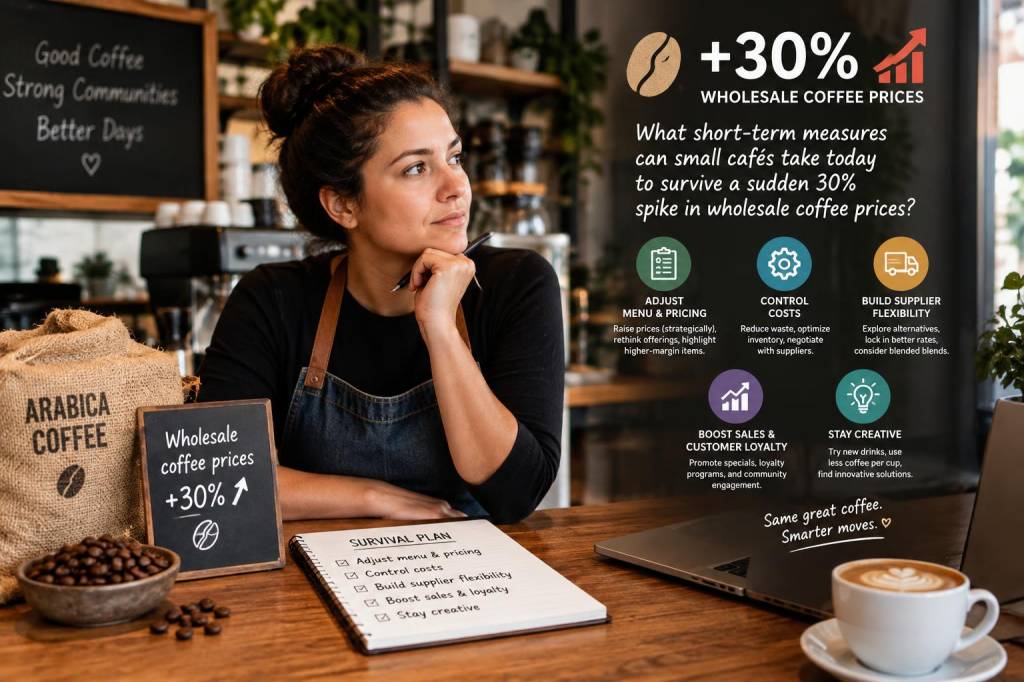
I remember the first time wholesale coffee prices jumped unexpectedly: it felt like someone had turned the dial on my margins and I hadn't been warned. For small cafés, a sudden 30% spike in the price of green or roasted beans is not an abstract macroeconomic story — it's an immediate existential threat. You can’t flip a switch overnight to recoup that cost, but you can take pragmatic short-term measures to stay afloat while you plan medium- and long-term responses.
Quick triage: what to check first
When prices spike, you need to make decisions fast and deliberate steps to stabilize cashflow. Here’s my immediate checklist:
- Check your current inventory and how long it will last at normal sales rates.
- Run the numbers on your current menu: which drinks have the highest coffee cost as a share of price?
- Talk to your supplier — you may have options like short-term price holds, mixed lots, or alternative bean grades.
- Communicate with staff and, critically, with customers — transparency builds goodwill if you must change prices or offerings.
Short-term pricing tactics that don’t alienate customers
Raising prices across the board is the simplest lever, but it risks losing customers if done clumsily. Here are gentler, targeted approaches I’ve found work better in practice:
- Introduce a small surcharge for specialty beans: If you offer single-origin or micro-lot espresso, add a modest “specialty bean” surcharge so regular drip coffee remains affordable.
- Incremental price nudges: Raise prices by a small amount (e.g., £0.10–£0.20) rather than a big jump. Customers tolerate gradual increases more readily.
- Size-based adjustments: Keep your base price for small/medium cups stable and increase large sizes. Many customers will opt for a smaller cup if the differential narrows.
- Bundle and value-upgrade: Offer a slight discount on coffee + pastry combos. You preserve perceived value while nudging spend per visit.
- Temporary price menu: Clearly label changes as temporary and linked to market conditions — honesty reduces backlash.
Menu engineering: reduce coffee intensity where it hurts least
Menu design is a powerful tool. The goal is to reduce the coffee-per-cup cost without making drinks feel cheap.
- Rethink espresso ratios: Pull slightly shorter shots (less liquid) or reduce dose by 0.5–1g if your baristas and customers won’t notice the flavor trade-off.
- Promote coffee-light options: Highlight Americano, filter coffee or smaller flat whites; they use less coffee per serving.
- Substitute milk-forward drinks: Increase focus on lattes and hot chocolates where milk is the main cost driver rather than beans.
- Smaller standard sizes: Reduce default cup size by a small increment (e.g., 12oz → 11oz) while keeping price consistent for a short period.
Supply tactics: stretch your beans ethically
There are operational choices to temporarily decrease coffee usage without ripping the soul out of your menu:
- Blend strategically: Mix your premium beans with a more affordable but still decent-quality base roast. Brands like Lavazza, Illy, or local roasters often offer blends that preserve drink consistency.
- Switch to a different roast profile: Some roasts are cheaper — for instance, a city roast vs. a specialty light roast — and can still satisfy customers if presented well.
- Negotiate flexible lots: Ask your roaster for mixed-origin lots or older stock at a lower price, while ensuring freshness standards.
- Use portion control tools: Invest in scales, dosing funnels or pre-measured portion packs to eliminate waste during busy shifts.
Cost-saving operations that move fast
These are back-of-house adjustments I’d implement immediately to protect margins:
- Tighten waste controls: Track waste by shift and identify where over-extraction, double pours, or overpouring is happening.
- Cross-train staff: Fewer mistakes and faster service mean less wastage and more throughput.
- Energy and supply savings: Reduce machine preheat time, optimize grinder cleaning schedules, and manage milk temp settings to lower utility bills slightly.
- Short-term labor adjustments: Use flexible shifts or stagger hours during slow periods rather than immediate layoffs.
Communications: how to tell customers without losing them
I’ve learned that customers appreciate honesty. The tone matters: avoid defensive language and lead with value.
- Signage at the counter: “Due to global supply changes, we’ve adjusted prices/offerings slightly — thank you for helping us keep serving quality coffee.”
- Social media posts: Share behind-the-scenes posts about sourcing and what you’re doing to keep quality high even while costs rise.
- Barista scripts: Give staff a short explanation to answer questions — empathetic and informative works best.
Short-term revenue boosts you can deploy this week
Some tactics drive immediate cash without feeling like price gouging:
- Prepaid bundles: Sell 10-coffee punch cards at a small discount to get cash now.
- Limited-time add-ons: Offer higher-margin items like flavored syrups, specialty toppings or seasonal pastries.
- Local partnerships: Host a pop-up or collaborate with a bakery or bookshop to bring in new customers.
Quick comparison: absorb cost vs. pass it on
| Option | Short-term cash impact | Customer reaction risk | Operational effort |
|---|---|---|---|
| Absorb cost | Negative — reduces margin | Low | Low |
| Raise prices | Positive — immediate margin recovery | Medium | Low |
| Switch beans/blend | Positive — lower input cost | Medium (if taste changes) | Medium |
| Reduce portion size/shot dose | Positive — saves beans | Medium | High (training) |
When to call your roaster and what to ask
Be proactive. Your roaster is often your best ally because they see the market too. Ask about:
- Short-term price protection or staggered shipments.
- Smaller pack sizes to manage cashflow.
- Temporary blends or older stock that still meets quality standards.
- Barista training support to optimize extraction and reduce waste.
In those first frantic days after a 30% jump, the right mix is transparency, quick operational fixes, and targeted pricing or menu changes. You don’t have to solve everything at once — prioritize measures that stabilize cashflow and preserve customer loyalty while you map a sustainable course forward.