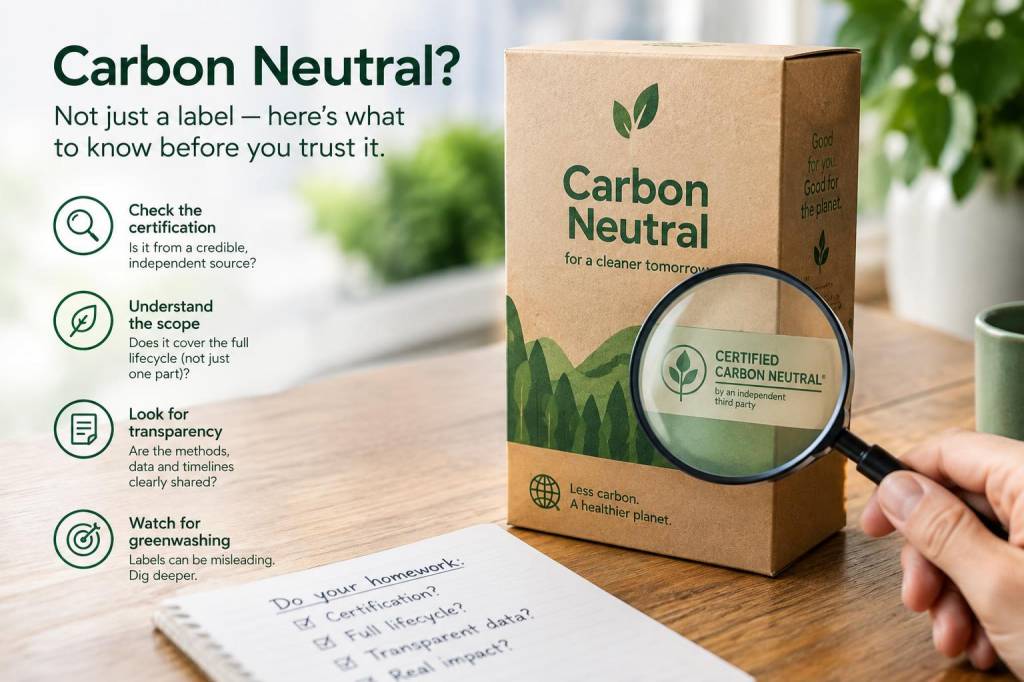
I have learned to treat a carbon-neutral claim on packaging as a starting point, not a final answer. When I see those words on a box, bottle, pouch, or label, I do not automatically assume a product has zero climate impact. I assume a company is making a promise that needs context, evidence, and a careful reading of the fine print. That matters because packaging is often the first place a brand tries to signal environmental responsibility, and it is also one of the easiest places for vague language to slip through.
When I look closely, I usually find that “carbon-neutral” can mean very different things depending on who is saying it, what exactly is being measured, and whether the brand has reduced emissions or simply paid to offset them. For readers, that distinction is important. A claim can be technically true and still be misleading if it leaves out the parts that matter most.
What carbon-neutral usually means in practice
In simple terms, a carbon-neutral claim suggests that a product, service, or company has balanced out its greenhouse gas emissions so the net result is zero. In reality, that balance often comes from a mix of internal reductions and carbon credits, and those two pieces are not equally strong. I always want to know whether the brand has actually lowered emissions in its operations, supply chain, and packaging, or whether it has mainly purchased offsets to cover what remains.
That difference is not academic. If a brand says a shampoo bottle or snack wrapper is carbon neutral, it may be referring only to packaging emissions, not the entire product lifecycle. Or it may be referring to a limited calculation that excludes agriculture, transport, retail storage, consumer use, or end-of-life disposal. The claim can be narrow even when the language sounds broad.
When I read packaging, I ask myself a few basic questions: What is being counted? What is being left out? Who verified the numbers? And what actions were taken before offsets were used?
Why offsets deserve extra scrutiny
I pay especially close attention when a carbon-neutral claim depends heavily on offsets. Offsets can fund projects such as reforestation, renewable energy, methane capture, or forest protection. Some of those projects can be useful, but they are not all equal, and they are not a substitute for cutting emissions at the source.
The risk is that offsets can create a comforting story without requiring meaningful changes in production. A company may continue using fossil-fuel-heavy shipping, energy-intensive manufacturing, or excessive packaging while claiming neutrality because it bought credits somewhere else. That is why I never treat offsetting as a magic eraser. It may be part of a credible climate strategy, but only if the company also proves real reductions first.
I also want to know whether the offset project is durable, additional, and independently verified. Those words sound technical, but they matter. Durable means the climate benefit lasts. Additional means the project would not have happened anyway. Verified means a third party checked the claim. Without those protections, offsets can look better on paper than they are in the real world.
What readers should look for on the pack
Packaging space is limited, so brands often compress their claims into short phrases. I have found that the most honest labels usually include supporting information, a reference to a methodology, or a clear route to learn more. If a package simply says “carbon neutral” with no context, I become cautious immediately.
Here is what I usually look for:
- A specific scope, such as packaging only, product only, or full company operations
- A named standard or certification body
- A year or reporting period for the claim
- A web address or QR code leading to a full explanation
- An explanation of reductions versus offsets
- Evidence that emissions data were independently reviewed
If those details are missing, I assume the claim may be marketing first and climate accountability second. That does not automatically mean the company is dishonest, but it does mean I want more evidence before I trust the message.
Labels, certifications, and what they can actually tell you
Some claims are backed by standards that make them more credible. Others are self-declared, which means the brand created the claim itself. I always prefer a claim that can be checked against a recognized framework, especially when it involves something as complex as climate accounting.
Still, even a certification is not a free pass. It is worth asking what the standard measures and what it does not. Some systems focus on emissions from production, while others may include packaging, logistics, or end-of-life assumptions. A seal may confirm that a process followed certain rules, but it may not tell you whether the product is genuinely low-carbon compared with alternatives.
| Question | What I want to see | Why it matters |
|---|---|---|
| What does “carbon neutral” cover? | Product, packaging, company, or a defined part of the supply chain | Broad wording can hide narrow accounting |
| Are emissions reduced first? | Yes, with offsets used only for remaining emissions | Reduction is stronger than compensation |
| Are offsets verified? | Independent third-party review and clear project details | Offsets vary widely in quality |
| Is data public? | Methodology, boundary, and reporting period available | Transparency makes claims easier to trust |
| Is the claim current? | Recent reporting, not an old campaign statement | Climate data can become outdated quickly |
Why packaging claims can be especially slippery
I think packaging creates a special problem because it is visible, simple, and emotionally persuasive. If I hold a bottle that says carbon neutral, I may instinctively feel that the entire product is climate-conscious. But packaging is only one slice of a much larger footprint. A drink in a clever recyclable bottle can still carry a heavy carbon load if ingredients are shipped long distances, if production is energy intensive, or if the disposal system is weak.
This is why I try not to confuse packaging design with climate performance. A greener-looking label, a forest image, or a leaf icon does not prove much on its own. In fact, those visual cues can sometimes do more work than the data. I have seen brands lean on recycled colors, minimalist layouts, and soft language while giving very little concrete evidence about actual emissions.
That is also why I pay attention to wording such as “net zero,” “climate neutral,” and “carbon balanced.” These terms can sound interchangeable, but they may reflect different methodologies. If a brand uses one of them, I want the company to explain exactly what it means in that context.
Questions I would ask before believing a claim
When I want to evaluate a carbon-neutral claim with more confidence, I ask a brand, or the information page behind the label, a few direct questions. I find that honest companies usually have clear answers ready.
- What emissions were measured?
- Was the assessment based on a life-cycle analysis or a partial estimate?
- Were raw materials, manufacturing, transport, storage, retail, and disposal included?
- What reductions were made before offsets were purchased?
- Which offset projects were used?
- Who verified the numbers?
- How often is the claim updated?
- Is there a plan to remove the need for offsets over time?
Those questions may sound demanding, but climate claims should invite scrutiny. If a brand is serious about neutrality, it should be prepared to show its work.
Red flags that make me cautious
There are a few warning signs that immediately make me less trusting. One is a claim with no methodology at all. Another is a claim that relies on vague phrases such as “environmentally friendly” or “planet positive” without measurable support. I also become wary when a brand highlights a single offset project while saying little about its actual emissions footprint.
Another red flag is when a company presents carbon neutrality as if it were a permanent achievement rather than a snapshot in time. A product may be carbon neutral for one batch, one year, or one market and not for another. If the claim lacks a date or boundary, I assume it may not be as robust as it appears.
I also watch for claims that celebrate neutrality while ignoring larger patterns of overproduction or waste. A company can offset one product line while still expanding a business model that generates more emissions overall. That is why I prefer brands that connect packaging claims to broader decarbonization efforts.
What a credible brand usually does differently
In my experience, brands that are genuinely serious about climate accountability tend to say less and show more. They explain the boundary of the claim, publish methodology, name the standard used, and describe real reductions alongside offsets. They may even admit where uncertainty remains, which I find far more trustworthy than polished certainty with no evidence behind it.
I also notice whether a brand talks about progress over time. A strong climate strategy should not stop at neutral packaging. It should aim to reduce materials, switch to renewable energy, improve logistics, redesign products, and measure results year after year. If a company only markets neutrality but never discusses deeper changes, I take that as a signal to keep asking questions.
For me, trust grows when the claim feels earned. That means fewer slogans, more data; fewer broad promises, more specific boundaries; fewer offset headlines, more actual emission cuts. If a brand makes that level of detail easy to find, I am much more likely to believe what I am reading on the pack.
And if it does not, I keep reading, keep checking, and keep my skepticism close.