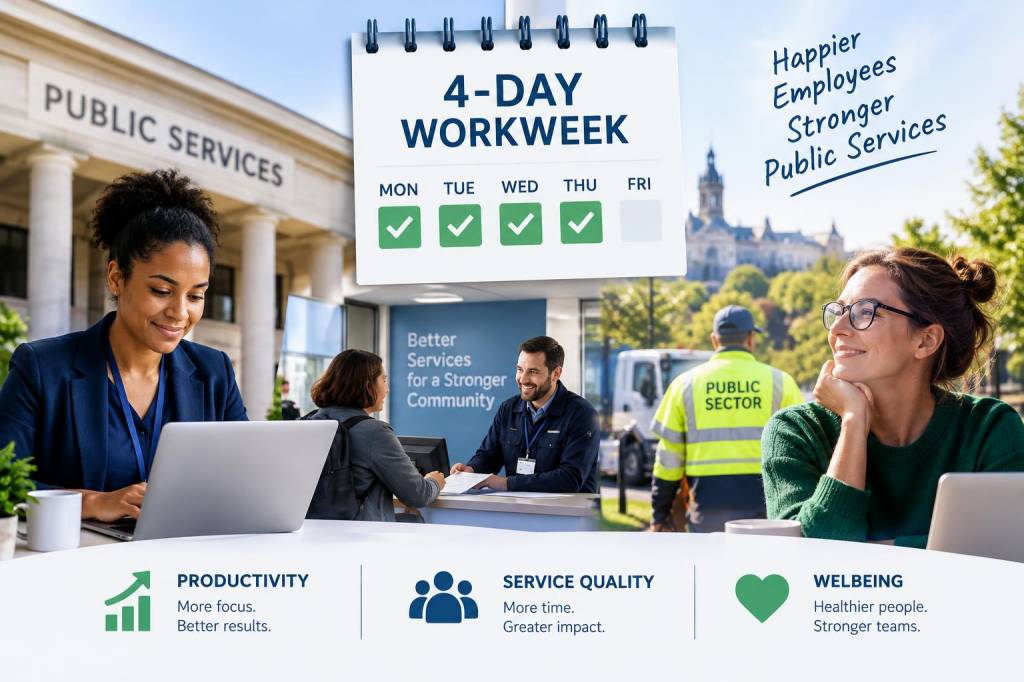
I keep coming back to the same question whenever the four-day workweek comes up in public policy circles: what happens when a government asks less of people in hours, but perhaps more of them in focus, coordination, and judgment? In public service, that question matters even more than in private business, because productivity is not only a matter of output. It is also about response times, trust, continuity, and whether citizens feel served when they need help.
If a nationwide four-day workweek were introduced across public-sector institutions, I do not think it would simply mean one extra day off. It would force a full redesign of schedules, staffing, workflows, and service delivery. Some departments would adapt quickly. Others would struggle. A few might discover that their current five-day model already hides waste that nobody has wanted to name. That is why this idea deserves a serious, practical discussion rather than a symbolic one.
What productivity would actually mean in public service
In private companies, productivity is often measured through revenue, sales, or output per worker. In public-sector work, I see a more complicated picture. A call center answering tax questions, a licensing office processing applications, a hospital administration team, a child protection unit, and a transport regulator all serve very different missions. A shorter week could improve productivity in one setting and damage it in another if leaders apply it carelessly.
For me, public-sector productivity should be measured through throughput, accuracy, timeliness, and citizen satisfaction. If a department processes more requests with fewer errors in less time, that is a real gain. If a ministry keeps the same service standards while reducing burnout and absenteeism, that also counts. But if a shorter week simply compresses delays into fewer working days, citizens will notice immediately, and trust will fall.
I would expect some short-term gains from better concentration. People working under time pressure often waste less time in unnecessary meetings, fragmented emails, and low-value reporting. I have seen many organizations discover that a shorter week can expose habits they no longer question. Once people know their time is limited, they often simplify forms, reduce duplication, and make decisions faster. That can be healthy. Still, public institutions cannot rely on pressure alone. They need systems that support speed without sacrificing fairness.
Service quality would depend on coverage, not slogans
The phrase “four-day workweek” sounds neat, but public services do not live inside neat slogans. Citizens need help on Monday morning, Friday afternoon, and often at the exact moment when a problem becomes urgent. A nationwide change would only protect service quality if leaders redesign access around coverage, not just employee schedules.
That means different teams may need different arrangements. Some staff could work staggered days. Some services could extend hours across the week. Some could rely more on digital systems, while others would need in-person continuity. A public hospital, for example, cannot simply close on the fifth day. A benefits office cannot leave vulnerable people waiting because everyone is off on the same day. A district council cannot let permit applications stall because one workflow is now stretched too thin.
I think this is where public-sector reform gets difficult. A four-day week can be excellent for knowledge work, planning, analysis, and internal coordination. It becomes harder where a service depends on public counter hours, physical presence, emergency response, or high-volume case handling. That does not make the policy impossible. It means a national version would have to be flexible enough to respect each service’s reality.
Where I think a four-day week could work well
Some parts of government are already close to a four-day model in practice, even if nobody calls it that. Many policy teams, communications units, research offices, and administrative departments spend a lot of time on reading, drafting, editing, reviewing, and cross-checking. In those environments, fewer interruptions can produce better work. I have often noticed that the quality of analysis improves when teams have longer uninterrupted blocks of time rather than a constant stream of meetings.
A four-day week could also be attractive in roles where recruitment and retention are difficult. Public-sector employers often compete with private firms that can offer better salaries, faster promotion, or more flexibility. A shorter week may not solve every staffing problem, but it can be a meaningful advantage, especially for experienced workers who value balance as much as pay.
I would also expect benefits in mental health and retention. Burnout is expensive. When skilled staff leave, institutions lose memory, training investment, and stability. If a shorter week reduces exhaustion, the public sector might gain more continuity than it loses in hours. That is especially true in jobs where emotional strain is high and mistakes are costly.
Where I think it could create real pressure
The biggest risk is simple: demand does not shrink just because the calendar changes. Citizens will still apply for passports, seek housing help, request social support, call about taxes, and report emergencies. If staffing levels remain unchanged while hours fall, waiting times can rise unless processes improve at the same time.
I worry most about services that already operate under strain. In those settings, a shorter week could become a hidden rationing system. Staff may feel better, but users may experience slower answers, fewer appointments, and more handoffs between teams. That would be politically damaging and ethically awkward. Public institutions exist to serve everyone, including people who cannot adapt easily to reduced hours, online-only systems, or delayed callbacks.
Another concern is uneven implementation. If one department gets a flexible four-day schedule while another keeps five long days, morale can suffer. If managers treat the policy as a perk for office staff but not for frontline workers, resentment will spread quickly. A nationwide model would need clear principles and local adaptation, not a random patchwork of favors.
What I would want to see before any national rollout
If I were assessing this policy, I would insist on hard evidence rather than enthusiasm. Pilot programs should measure more than employee happiness. They should examine response times, service completion rates, error rates, absenteeism, retention, overtime, citizen complaints, and cost per transaction. Without that data, everyone will simply argue from instinct.
| Area | Possible gain | Possible risk |
|---|---|---|
| Administrative teams | Better focus, less burnout, faster decision-making | Backlogs if workflows are not redesigned |
| Citizen-facing services | Higher morale, stronger retention, smoother handoffs | Longer queues and slower response if coverage drops |
| Emergency and care services | Reduced fatigue in some support roles | Severe staffing pressure if hours are cut without extra coverage |
| Digital services | Efficiency gains from simplified processes | Service gaps for users who need human support |
I also think leaders would need to separate hours worked from value created. Too many public organizations still measure effort through visible presence rather than outcomes. A shorter week could push managers to ask better questions: Which tasks are essential? Which approvals are redundant? Which reports are never read? Which meetings exist only because nobody has challenged them? That kind of discipline would be useful even if the four-day week never became permanent.
What citizens would notice first
From a citizen’s point of view, service quality would be judged through experience, not policy language. People would notice whether phone calls are answered, whether forms are processed on time, whether appointments are available, and whether staff seem rushed or clear-headed. If a four-day week improves all of that, public support could grow fast. If it creates delays, the backlash would be just as fast.
I think the public would accept the idea more readily if service levels stayed visible and reliable. For example, a department could publish opening hours, expected response times, and alternate access routes. If citizens know when to expect service, frustration drops. Uncertainty is often worse than delay. In that sense, transparency would matter almost as much as staffing.
There is also a political dimension. A national four-day week in the public sector would not be seen as a technical management reform alone. People would read it as a statement about work, fairness, and the value of public employees. Supporters would say it reflects a modern state that trusts its workforce. Critics would say it risks making government less available. Both reactions are understandable, which is why the design details matter so much.
My sense of the deeper trade-off
At its core, this debate is not really about a missing day. It is about whether public institutions can deliver better services by working differently instead of simply working longer. I think that question is worth asking because the old assumption — more hours automatically mean more output — is often too lazy to survive scrutiny.
Still, I would not pretend that a four-day week is a magic solution. For public-sector productivity to improve, leaders would need to invest in technology, simplify procedures, train managers, and protect service continuity. Without those changes, shorter hours may just redistribute pressure. With them, a four-day week could become a catalyst for a more efficient, more humane public sector.
What I find most interesting is that this debate forces institutions to confront an uncomfortable truth: many public services are not limited by people’s commitment, but by outdated systems, poor coordination, and administrative drag. If a shorter week pushes those weaknesses into the open, that alone may be valuable. If it also improves morale and retention, even better. But if governments want both higher productivity and stronger service quality, they will need to design the change carefully, monitor it honestly, and be ready to adjust quickly when reality refuses to match the slogan.
I would watch closely for one simple test: when people inside the system feel less exhausted, do citizens actually receive better service? If yes, then the four-day week may be more than a labor perk. It may be a serious reform worth expanding.