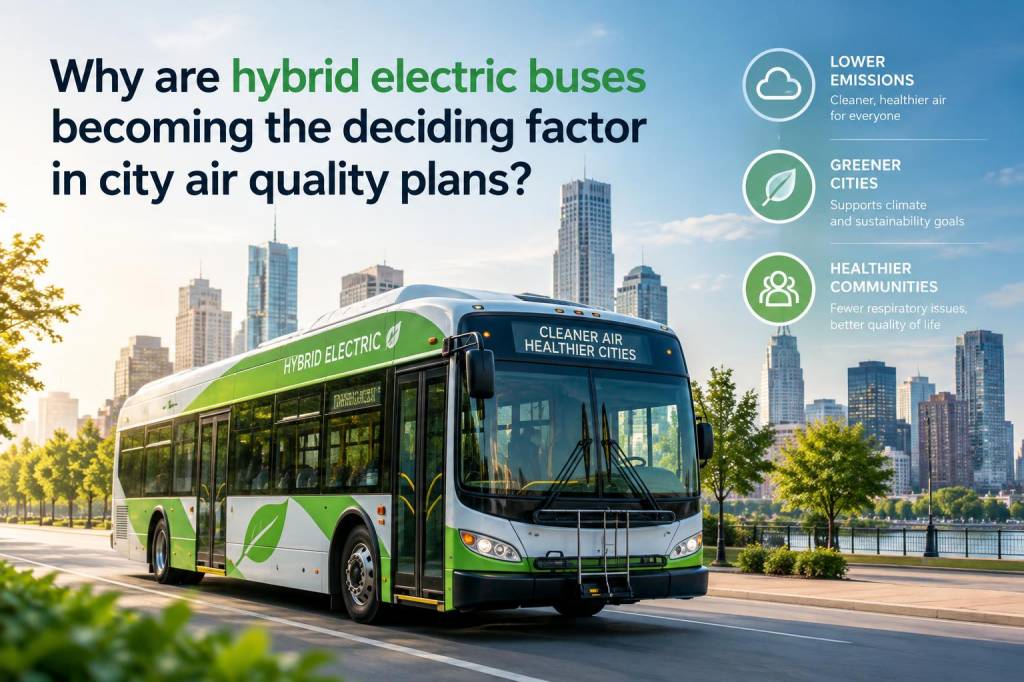
I have watched city transport debates shift from abstract climate promises to practical air-quality decisions, and hybrid electric buses now sit at the center of that shift. When city leaders talk about cleaner streets, fewer asthma triggers, and faster progress without rebuilding every depot at once, buses are often where the conversation becomes real. I think that is why hybrid electric buses are no longer a side option. They are becoming the deciding factor in air-quality plans because they sit at a rare intersection of speed, cost, reliability, and visible public impact.
What makes this moment different is that many cities no longer ask whether they should cut transport emissions. They ask how fast and at what cost. Fully electric fleets get a lot of attention, and for good reason, but I keep seeing transport agencies turn to hybrids when they need immediate results without waiting for a perfect charging network, a full grid upgrade, or a complete depot redesign. A hybrid bus can cut fuel use and local pollution today, while still fitting into daily service patterns that cities already know how to manage.
Why air quality pushes cities toward hybrids
Urban air quality is shaped by many sources, but road transport remains one of the most visible and politically sensitive. Buses matter more than their share of traffic might suggest because they run long hours, stop often, idle in dense areas, and pass through corridors where people live, work, and wait on sidewalks. When I walk through a busy transit corridor, I can see why this matters: even a modest improvement in exhaust emissions can make a noticeable difference in places where pedestrians and bus riders breathe the same air for hours each day.
Hybrid electric buses reduce emissions in a way that city officials can measure quickly. They use electric assistance to ease engine load, recover energy during braking, and reduce fuel burn in stop-start traffic. That means lower carbon dioxide, lower nitrogen oxides, and often less particulate pollution compared with a conventional diesel bus. For air-quality plans, those reductions are attractive because they happen within existing routes, not only in future pilot districts or brand-new transit corridors.
What I find especially important is that air-quality policy is often judged on near-term results. Voters, health departments, and city councils want evidence that children near schools, older adults near busy roads, and residents in dense neighborhoods will breathe cleaner air soon, not only in ten years. Hybrids fit that timeline better than many long-range plans because they can be deployed in numbers without waiting for every barrier to disappear.
Why hybrids are easier to adopt than full battery fleets
Fully electric buses are a long-term destination for many cities, but I do not think every transit system can move there at once. Battery buses need charging infrastructure, grid capacity, careful route planning, maintenance training, and spare vehicles to protect service during charging downtime or battery-related issues. For large networks with aging depots or tight budgets, that is a major lift.
Hybrid electric buses ask less of a city on day one. They can often use existing fueling infrastructure, existing routes, and much of the existing maintenance setup. That flexibility matters when transport agencies are already balancing fare revenue, labor agreements, fleet replacement schedules, and service reliability. I have seen city planners become more confident with hybrids because they can improve air quality now while preparing for deeper electrification later.
There is also a political dimension. A mayor can announce cleaner buses, show visible fleet upgrades, and point to reduced emissions without waiting for a large infrastructure rollout. That matters in public life. Air-quality plans are not only engineering documents; they are also promises. Hybrids let leaders keep those promises in a way residents can see on the street.
What people notice most is not always carbon
Many public conversations about bus electrification focus on climate, but people living near traffic usually notice local air pollution first. They care about fumes at stops, noise from engines, and the sense that traffic corridors never truly clear. Hybrid electric buses help with all three, even if the effect is not as dramatic as a fully zero-emission vehicle in every case.
I think this is one reason hybrids keep showing up in city health discussions. A transit agency may explain carbon savings in a report, but residents often respond to what they feel day to day: quieter acceleration, fewer harsh exhaust bursts, and less visible smoke in traffic queues. That experience matters because public support for air-quality policy grows when people believe improvement is real, not just statistical.
There is another practical benefit: hybrids can reduce engine stress in stop-and-go service, which is exactly where many city buses spend much of their life. Urban routes are rarely smooth highway runs. They are full of braking, restarting, crawling through congestion, and waiting at crowded intersections. Hybrid systems are built for that pattern, so they make sense in the exact conditions that create most city pollution.
Where hybrids fit in a larger transport strategy
I do not see hybrids as a permanent endpoint for every city, and I do not think serious planners should. Instead, I see them as a bridge that can deliver measurable gains while a broader transition takes shape. In practice, that means a city may use hybrids on routes with heavy passenger loads and dense air-quality sensitivity, while reserving future battery or hydrogen investment for routes and depots that can support it.
That strategy often looks like this:
- Deploy hybrids on high-frequency urban routes where stop-start driving is common.
- Prioritize corridors near schools, hospitals, and dense residential blocks.
- Use hybrid savings to free budget for charging infrastructure or depot upgrades.
- Collect route-level emissions data to guide future fleet decisions.
- Replace older diesel buses first, since the air-quality gains are largest there.
I like this approach because it is not ideological. It treats fleet change as a sequence of practical choices, not a single dramatic leap. A city that starts with hybrids may later move more smoothly to full battery electric buses because it has already trained staff, updated operations, and proven that cleaner transport can work without disrupting service.
Costs, maintenance, and public value
Budget is often the hidden force behind air-quality policy. A city may genuinely want cleaner buses, but if the numbers do not work, plans stall. Hybrids frequently offer a middle ground: lower operating fuel use than conventional diesel, less infrastructure pressure than full electrification, and a capital cost that can be easier to absorb across a large fleet renewal cycle.
Maintenance can also be a deciding factor. Transit agencies need vehicles that can survive heavy use, uneven driving conditions, and high mileage. Hybrid buses add complexity compared with standard diesel models, but they are still often simpler to support than a fully electric system that depends on charging timing, battery health management, and power distribution at scale. In many cities, the question is not which technology sounds cleanest on paper. It is which one will keep buses moving while improving air quality enough to matter.
Public value is where hybrids gain strength. If a city can reduce emissions on a major bus corridor, improve rider comfort, and preserve service frequency, it gets a strong return even before a full zero-emission transition. That combination matters to me because air-quality policy should not feel like a luxury upgrade for wealthy districts only. It should deliver visible benefit where pollution exposure is highest.
What makes hybrid buses politically powerful
One reason hybrids have become so influential is that they are easy to explain. A city can say it is cutting pollution, saving fuel, and improving health without requiring every resident to understand grid constraints or battery chemistry. That simplicity makes hybrids politically durable. They are tangible, and they produce a clean-looking story for both city hall and the public.
They also create room for compromise. Environmental advocates can support them as a meaningful step forward, while budget officials can back them as a manageable investment. Transit managers can value them because they reduce risk. When a policy tool can satisfy so many different stakeholders, it tends to move quickly from experimental to essential.
| City Need | Why Hybrid Buses Help |
|---|---|
| Fast air-quality improvement | Lower exhaust emissions on existing routes without waiting for full infrastructure buildout |
| Budget pressure | Often easier to introduce than a full battery system across an entire fleet |
| Service reliability | Fits current operations with less disruption than a complete fleet redesign |
| Public visibility | Residents can see cleaner vehicles in daily use across busy corridors |
| Long-term planning | Creates a transition path toward deeper electrification later |
Why this matters now
I think hybrid electric buses are becoming the deciding factor because cities are under pressure to prove progress in a world where climate goals, public health, and fiscal reality all collide. A bus fleet is one of the few places where a city can make a visible, measurable, street-level improvement relatively quickly. That matters in air-quality planning because people do not live inside policy documents. They live beside roads, wait at bus stops, and breathe what traffic leaves behind.
When I look at the direction city transport policy is moving, I see less interest in symbolic change and more demand for systems that work under real conditions. Hybrid electric buses answer that demand better than many alternatives because they are not asking cities to choose between action and practicality. They offer cleaner air, smoother transitions, and a realistic path through the messy middle of urban decarbonization.
That is why, in many cities, the debate is no longer whether hybrid buses matter. It is where they should go first, how quickly they can be scaled, and which neighborhoods should feel the benefit earliest.