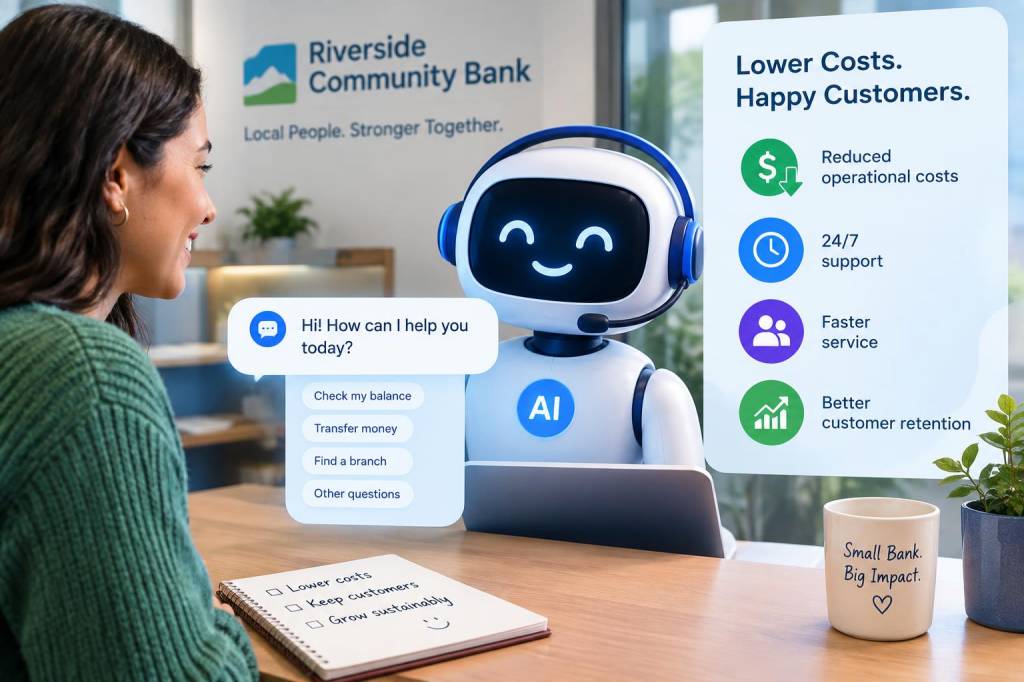
I have watched small banks wrestle with a hard question for years: how do you keep service personal when customers now expect instant answers at any hour? That pressure has only grown as digital banking has become a default habit rather than a novelty. When I look at AI customer-service chatbots, I do not see a magic fix. I see a tool that can lower routine-service costs, but only if banks deploy it with discipline, honesty, and a clear sense of where automation should stop.
Why small banks are paying attention
For a small bank, customer service is not just a support function. It is part of the brand. A local institution often competes against national banks, digital-only challengers, and fintech apps that can answer questions faster and at lower cost. Every phone call, branch visit, and live-chat session carries a price, and those costs add up quickly when customers ask the same questions again and again: card replacement, balance checks, wire status, loan payment dates, password resets, branch hours, and fee explanations.
That is where chatbots enter the conversation. If a bot can resolve a large share of routine questions, a bank may reduce call-center volume, shorten wait times, and free human staff for more valuable work. I understand why executives find that appealing. A small bank does not usually have endless budget room for large service teams, especially when margins are tight and regulatory costs keep climbing.
What interests me most is that this is not only a cost story. It is also a service design story. A chatbot can be a front door, a triage layer, or even a round-the-clock helper that handles simple tasks before passing a customer to a person. Used well, it can make a bank feel more responsive. Used poorly, it can make a bank feel cold, evasive, and inaccessible.
Where chatbots save money in practice
From what I have seen, the biggest savings come from deflecting repetitive work. If 20 percent or 30 percent of inbound contacts are basic and predictable, a bot can absorb some of that load without forcing a human employee to repeat the same answer hundreds of times each week. That can mean fewer overtime hours, lower staffing pressure during peak periods, and a smaller burden on support teams during nights and weekends.
There is also a training advantage. New support staff often need time to learn product rules, compliance language, and service workflows. A well-built chatbot can serve as a knowledge layer that gives consistent answers and helps staff find information faster. In that sense, it is not only replacing work; it is organizing work.
Another area where small banks may save money is after-hours service. A fully staffed 24-hour phone operation is expensive. If customers can ask a bot about transaction timing, card travel notices, or digital-banking login issues at midnight, the bank can avoid paying a person to answer every simple question outside business hours. That matters for institutions trying to offer modern convenience without building a giant support operation.
Still, I would be careful not to overstate the savings. A bot costs money to build, integrate, test, monitor, and improve. If a bank chooses a weak vendor, the project can become an expensive disappointment. Savings appear only when the system is connected to real back-office processes and managed with ongoing attention.
Where customer patience runs out
Customers forgive a slow answer less often than they once did, but they also expect empathy when money is involved. That is where many chatbots fail. A bot can be excellent at identifying a lost debit card or explaining branch hours. It becomes much less reassuring when a customer is locked out of an account, disputing fraud, worried about a denied loan, or trying to understand a fee that feels unfair.
I think this emotional gap is one of the most important risks. Banking is not like ordering a meal or tracking a parcel. A customer may be anxious, frustrated, embarrassed, or suspicious. If a chatbot keeps repeating itself, asks the same question three times, or cannot recognize urgency, the experience can feel dismissive. That moment can damage trust far more than a slightly slower human response would.
There is also the danger of hallucinated or imprecise answers if a chatbot uses modern language-model technology without proper safeguards. In banking, a confident wrong answer is worse than no answer at all. A bot that gives incorrect fee information, misstates a policy, or misunderstands an eligibility rule can create complaints, compliance problems, and reputational harm. For me, that means accuracy must outrank novelty every time.
What a good rollout should look like
I would want a small bank to start narrow, not broad. The safest use cases are the boring ones: balances, transaction history pointers, branch and ATM information, card replacement steps, login help, and simple product FAQs. These are high-volume, low-risk interactions where speed matters and the answers are usually structured.
A smart rollout should also make escalation easy. If a customer types “fraud,” “lost card,” “complaint,” or “cancel,” the bot should not trap them in a maze of scripted prompts. It should route the issue to a human quickly. That handoff should feel natural, not like a defeat.
I also think banks need to be transparent about what the bot is and is not. Customers should know they are speaking with an automated system. They should know when their conversation may be logged. They should know when a human will step in. Trust rises when expectations are clear, and trust falls when a system pretends to be more capable than it is.
In my view, the best systems also learn from service patterns without becoming careless. If many people ask about one confusing fee, that is not just a chatbot problem. It may be a product design problem. The bank should use the conversation data to simplify language, improve digital forms, and reduce unnecessary contact in the first place.
A simple comparison of likely outcomes
| Approach | Likely cost effect | Customer effect | Risk level |
|---|---|---|---|
| Basic FAQ bot | Moderate savings on repetitive calls | Faster answers for simple questions | Low |
| Integrated service bot | Higher savings if linked to account systems | Better self-service for routine tasks | Medium |
| Overconfident AI bot | Short-term savings, possible hidden losses | Frustration, mistrust, bad handoffs | High |
| Human-plus-bot model | Balanced savings and staffing relief | Fast first response with human backup | Lower than fully automated model |
What I would measure before calling it a success
If I were advising a small bank, I would not judge success by chatbot usage alone. High usage can mean customers like it, or it can mean they are stuck with it. I would want to see first-contact resolution, transfer rate to human staff, customer satisfaction after bot sessions, average handling time, complaint volume, and repeat-contact rates. If the bot lowers cost but increases frustration, it is not a win.
I would also watch abandonment closely. If people leave the chat before getting help, that is a red flag. So is a rise in branch visits or phone calls after the bot launches, because that may suggest customers no longer trust the digital channel. A chatbot should reduce friction, not push people back into longer, costlier channels.
Another metric I care about is consistency across customer groups. A tool that works well for younger digital users but fails older customers, non-native speakers, or people with accessibility needs can create service gaps. Banks should test for that early. A customer-service strategy that saves money for the institution but excludes part of the customer base is not sustainable in the long run.
What small banks may still need human staff for
I do not believe AI chatbots should replace the human side of banking. In my experience, many of the moments that matter most are the ones that require judgment, reassurance, or flexibility. A human agent can notice tone, adapt a script, make exceptions where policy allows, and calm a worried customer in a way a machine still cannot match.
Small banks often pride themselves on relationships. That is not marketing fluff; it is part of their economic identity. If customers feel they are talking to an institution that knows them, they may stay loyal even when a bigger competitor offers a slick app or a lower rate. A chatbot should support that relationship, not flatten it.
I would want service teams to keep control over complex cases, vulnerable customers, disputes, fraud concerns, hardship conversations, and anything with legal or regulatory sensitivity. Those are not places where automation should dominate. They are places where empathy and responsibility matter too much.
Used with care, AI customer-service chatbots can cut small-bank costs without driving customers away. Used carelessly, they can do the opposite. What matters is not whether a bank uses AI, but whether it uses it to remove friction, protect trust, and make human support stronger where it counts most.